
EV Charger Cable Guide
Published: Monday, 22 June 2026
One of the most essential pieces of equipment you’ll need for your electric car is a suitable EV charger cable. An EV charging cable is a vital tool that helps keep you on the move, and you may need to keep one handy depending on the type of EV charging station you have.
There is a diverse range of EV charging cables available on the market, so many electric vehicle owners find themselves bewildered at the prospect of choosing a suitable charger cable for their EV.
Most electric vehicles come equipped with at least one charger cable when purchased. However, if you’re on the market for a new EV cable, or if you simply want to get a better understanding of EV charger cables and how they work, we'll provide you with everything you need to know in this informative guide.
The different types of EV charger cables
There are a few different types of EV charger cables out there and the type that you’ll need depend on the type of charger you’re plugging into, your EVs charging port, and the charging speed you’d like.
A quick note on kilowatts before we get started: When it comes to EV chargers, a kilowatt (kW) is the unit used to measure has fast electricity can flow into your car.
Basically, chargers with a higher kW number will charger your car faster.
Now that’s out of the way, here’s a breakdown of the different types of EV charger cables and the kinds of vehicles they are suitable for:
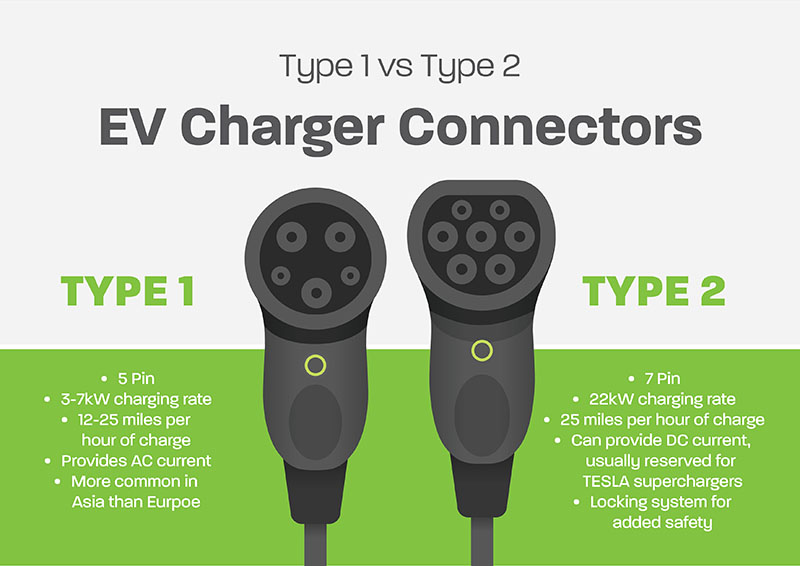
1. Type 1 EV Charging Cables
Type 1 charging cables have 5-Pins and are mostly found in cars from Asia like Mitsubishis, the Nissan Leaf (pre-2018) Toyota Prius (pre-2017), the Kia Soul and others, you’ll also find type 1 chargers in some non-Asian models like the Citroen C-Zer, Peugeot Galacia, Vauxhall Ampera.
If your car takes a type 1 charging cable, you’ll be able to get fast charging rates of about 3kW - 7kW, that will give you a range of around 12-25 miles per hour of charge.
Because type 1 charging cables are more popular in areas of Asia than in Europe, it can be difficult to find Type 1 charging facilities in the UK, so if you have a have a car that needs a that a Type 1 charger, it may be useful to invest in a Type 1 to Type 2 charging lead.
This cable will let you plug the Type 1 end into your car, and the Type 2 end into the charging station. The benefit is that you’ll be able to use the cable with Type 2 charging points that are most common in the UK & Europe. The most important thing to remember is that Type 1 EV chargers have 5 holes, are mostly found in older cars and go up to 7kW.
2. Type 2 EV Charger Cables
Type 2 EV charging cables are the standard that you’ll find in the UK and Europe and they offer fast charging rates of 3kW-7kW AC (single phase) and even 22kW (three phase) for an even faster charge. If you haven’t heard of single phase & three phase power before, don’t worry, we have more on that just below.
If you have a home charging station, or know someone who does, it’ll most probably have a Type 2 connector and will likely charge at 7kW or 7.4kW.
The 22kW charging is usually only available in public/commercial settings like supermarket & retail car parks, workplaces, and in some on-street residential areas.
Type 2 chargers get even faster and can deliver 150kW, 250kW, and even 350kW. Although you may not be able to find one of these stations in your area because these ‘ultra-rapid’ chargers are a lot less common than 22kW ones.
Type 2 EV cables can typically provide an estimated range of 25 miles per hour of charge.
Type 2 EV charging cable connectors are built with a locking mechanism to provide added safety and reliability for users.
The important thing to remember about Type 2 charging cables is that they have 7 pins and are the most common in homes and public spaces. This is the type you’ll need unless your car is very old model.
3. 3-Pin Charger Cable
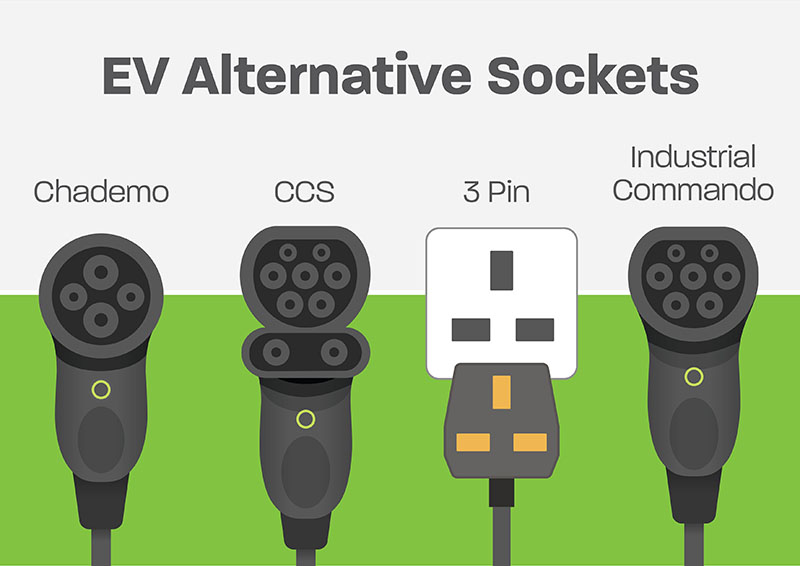
A 3-pin charger cable (AKA Mode 1 or portable EV charging cables) will plug into a standard power socket in your house and is the basic form of EV charging and is commonly used as a backup form of power.
As you can imagine, a socket made for your toaster will be very slow when charging a car so 3-pin charging cables are really only used for emergencies and as a last resort.3-Pin charging will give you around 8 miles per hour of charge).
We recommend investing in a home EV charger to access faster and more cost-effective charging at your home or property.
Alternatives
Alternative chargers are available however, they are much more niche and, things you are unlikely to be used for home property charging. These cables are: Industrial Commando, Combined Charging System (CCS), and CHAdeMO.
Industrial Commando – Used for charging industrial vehicles as they channel high voltage and amperage by providing AC power. Beneficial for outdoor use, as they cope well with exposure to water, dust, and dirt.
Combined Charging System (CCS) – An enhanced version of a type 2 charger. Providing two additional contact points allows for rapid charging of an output range of 50kW – 350kW supporting AC and DC facilities. Mile range of up to 525 miles per half hour of charge.
CHAdeMO – Once a mainstay of public charging stations, CHAdeMO is slowly being phased out for CCS. Using DC power, they can provide up to 100kW and approximately 150 miles per half hour of charging. If you are looking to buy a second-hand electric vehicle, it is important you check what socket it is using to avoid the potential risk of your vehicle being phased out.
What does single-phase and three-phase mean?
Many modern charging cables are designed with the ability to accommodate both single-phase and three-phase charging through auto-switching. This allows users to utilise three-phase charging cables on single-phase cars and charging points.
Single-phase AC power is used to charge standard power sockets in domestic residences, as well as facilitate slow charge 3-Pin EV charging. This power flows through one single conductor and can support a home charge unit of up to 7.4 kW.
Three-phase power cables are more powerful than single-phase connectors as they have two extra wires – L2 and L3. Three-phase connectors are commonly used in commercial buildings and for fast EV charging as they charge an electric vehicle three times faster than a single-phase cable.
What to consider when buying an EV charging cable
To determine the kind of EV cable required for your vehicle, you should consider the following:
Type 1 or 2?
Most cars in the UK and public chargers will use Type 2 charging cables, so vehicles manufactured for use in UK and Europe will use Type 2 charging cables. If you are looking for a second-hand EV, we recommend you double-check what charging cable they use as it could impact your whole EV charging setup. You should be able to find this information in your charger car’s user manual.
What length/size EV charging cable should I buy?
Select a suitable cable length – EV charging cables are typically between 4-10 metres in length. A charger cable length of 7.5m is usually recommended. You’ll need to ensure that the length you select is suitable in terms of being able to reach from your EV charger to your vehicle. You should also bear in mind that you will have to arrange suitable storage for the cable length you choose.
Current Rating
Pick an appropriate current rating – EV charger cables usually come in 16A and 32A; the latter option is heavier and thicker in appearance as it carries a higher amount of current. It is common for 3.6kW EV chargers to have a 16A supply of current, whilst 7kW wallboxes tend to have a 32A supply.
To futureproof your EV cable, you could opt to purchase a 32A cable, in case you choose to upgrade your EV in the future.
What is AC & DC?
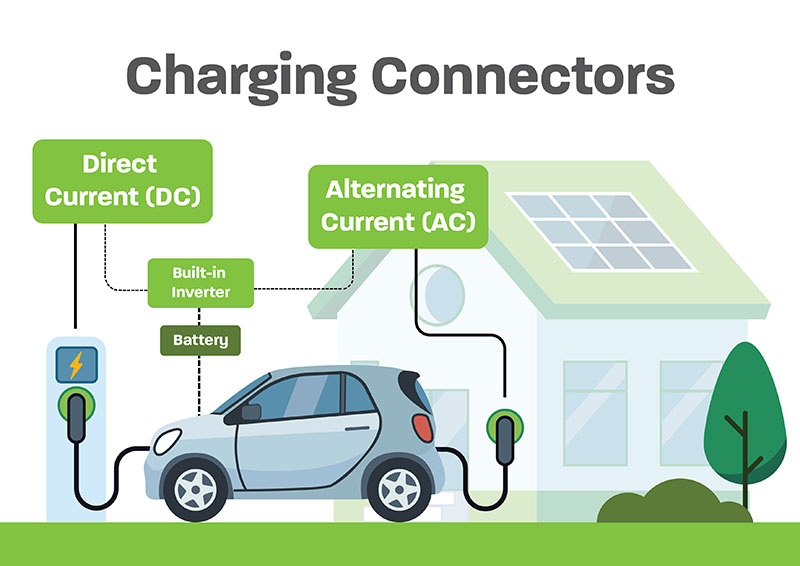
Alternating Current (AC) and (Direct Current) are the types of currents used in electrical vehicle charging.
AC - An electric current that regularly changes direction.
DC - Direct current consistently flows in one direction.
EV batteries require DC to charge. However, regular power sockets and standard charging systems only provide AC. As a result of this, the EV’s built-in charger will convert the AC to DC power. Fast charging EV systems are designed to provide DC straight to the car battery, omitting the conversion process and providing a quicker charge.
Tethered or untethered EV charger?
Deciding between a tethered and untethered charging cable is something you’ll have to think about when installing a charging station at home.
Tethered: The charging cable comes as an already connected attachment to the charger – like a petrol and diesel pump.
Untethered: Simply keep your cable in your car boot or at home, then connect one end to the station and the other to your car when you need to charge.
Tethered is the convenient option as your cable is ready to use whenever you need to charge at home.
Untethered cables help to future proof your charging setup as when you get a new electric vehicle, you won’t need to upgrade your entire EV charging system if your new vehicle has a different connector requirement.
As electric vehicles have begun to be standardised in the UK, it has made the process of choosing your EV much simpler. With type 2 charger cables being the standard in the UK you avoid the risk of investing in an EV charging system and not having the correct charger available. Please note, that if you are looking to purchase a second-hand electric vehicle, it would be best to check what cable it requires as some type 1 vehicles will still be available in the UK.
Choosing the right EV charging cable doesn’t have to be confusing. By understanding the difference between cable types, charging speeds, current ratings, and entered vs untethered setups, you’ll be in a much better position to choose a charging solution that suits both your vehicle and your lifestyle.
For most UK drivers, type 2 cable will be the standard choice but it’s always worth checking your vehicle requirements, especially if you’re buying a second-hand EV or futureproofing your charging setup.
Whether you’re upgrading your current charging equipment or buying your first EV charging cable, the team at YESSS Electrical can help you find the right solution.
If you’re looking for a new EV charging cable for your car charger, YESSS Electrical can provide you with an excellent solution. Our trained advisors can provide you with all the help and advice you need to find the right EV charging cable for your electric vehicle.
Here at YESSS Electrical, we supply a range of EV chargers and EV charging leads.